
The first six months of OSPREY focused on understanding the scale and complexity of online experiences by elected officials and police members, and the broader landscape of current laws, regulations and practices.
Mapping the Legal Landscape
Developing effective solutions to online harms requires a solid understanding of the law. Led by PROTECT (formerly CPI), OSPREY conducted a detailed analysis of legislation, policy, and regulatory frameworks across the EU and partner countries, identifying where protections for public-facing professionals (PFPs) exist, where gaps remain, and what remedies are available across five categories of harmful online conduct. Results show a lack of unified jurisdiction for PFP-targeted digital offences, limited mechanisms for platform accountability outside the EU’s DSA framework, uneven criminalisation of doxxing and NCII/deepfake conduct across jurisdictions and fragmentation of responsibilities to respond.
Mapping the Knowledge Landscape
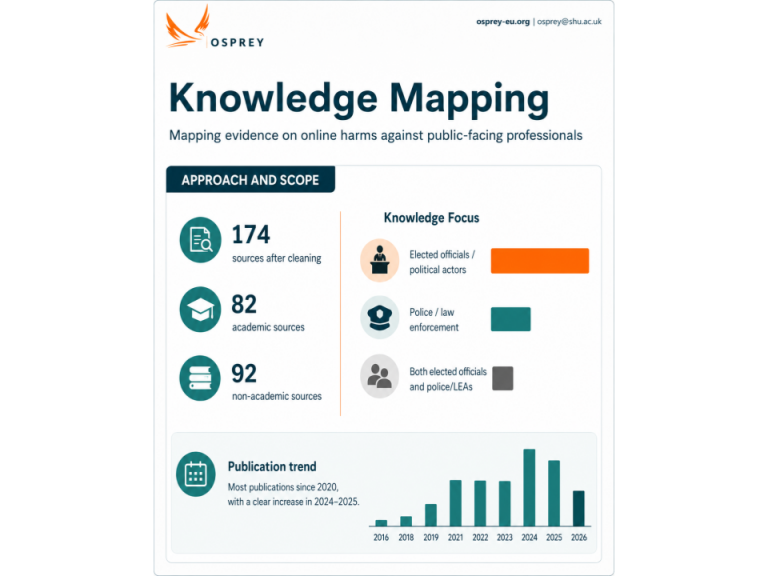
OSPREY conducted a systematic review of the current knowledge landscape. Led by CENTRIC, the systematic synthesis of existing research on online harms against PFPs offered valuable insights for the project. With a focus on academic and non-academic sources, such as publications from governments, organisations, and charities, the review highlighted the scale and nature of online harms against PFPs. The review also uncovered gaps in the literature and our collective knowledge, particularly around online harms towards police officers and staff.
First-hand Reports
To understand online experiences first-hand, OSPREY partners conducted in-depth interviews with politicians, police officers/staff, as well as investigators and managers across nine countries. The first-hand reports identified the complexity of the online threat and harms landscape, across a wide range of channels and forms. From the information, OSPREY created an online harms taxonomy against PFPs, with sub-taxonomies that outline specific harm types in politics and policing, and an architecture for its technical solutions.
Library of Current and Best Practices
In parallel, OSPREY also started building its Library of Current and Best Practices, drawing together approaches for the prevention, mitigation and investigation of online harms, as well as approaches for support and wellbeing.